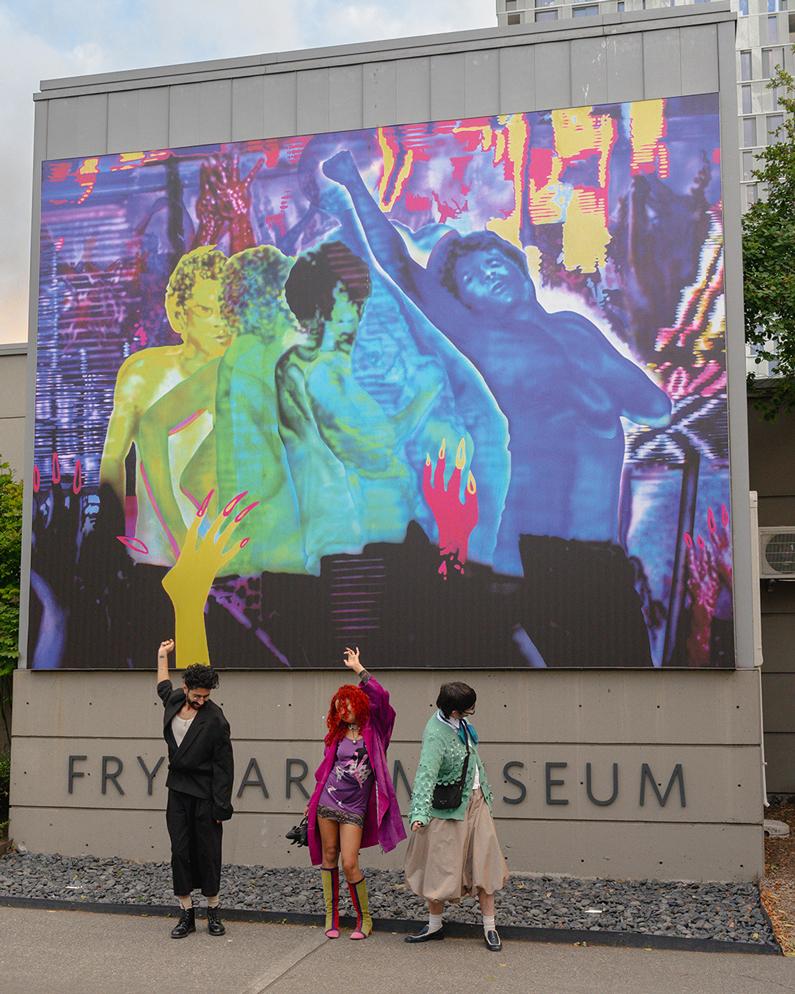
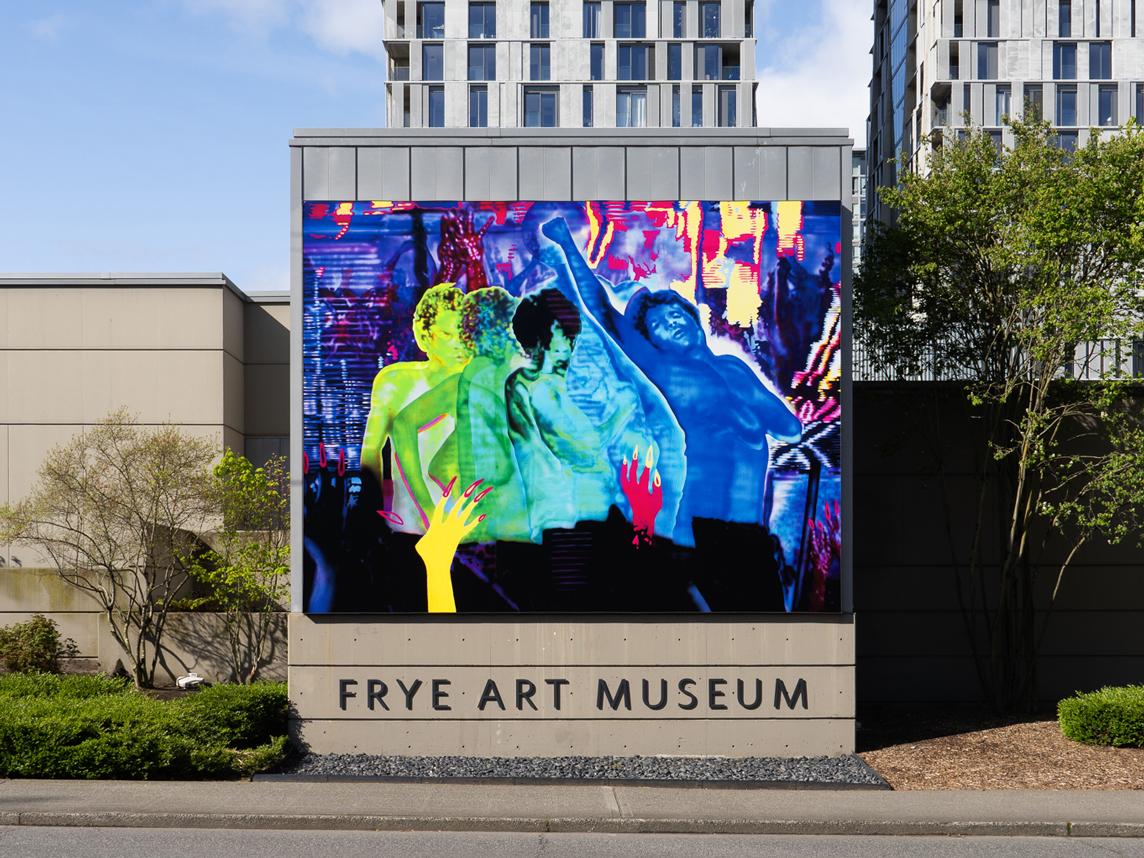
Artist Chloe King's Dancing My Way to Drexciya (2026) is on view at the Frye as part of the Boren Banner Series through October 11, 2026. In this post, King reflects on her process and inspirations for the Boren Banner artwork.
Snip. Cut. Scissor. Stitch. My practice begins on the dance floor these days. Hands glitching as beats per minute rise to a tempo that demands heavy breath, bouncing soles, and light, sharp hands.
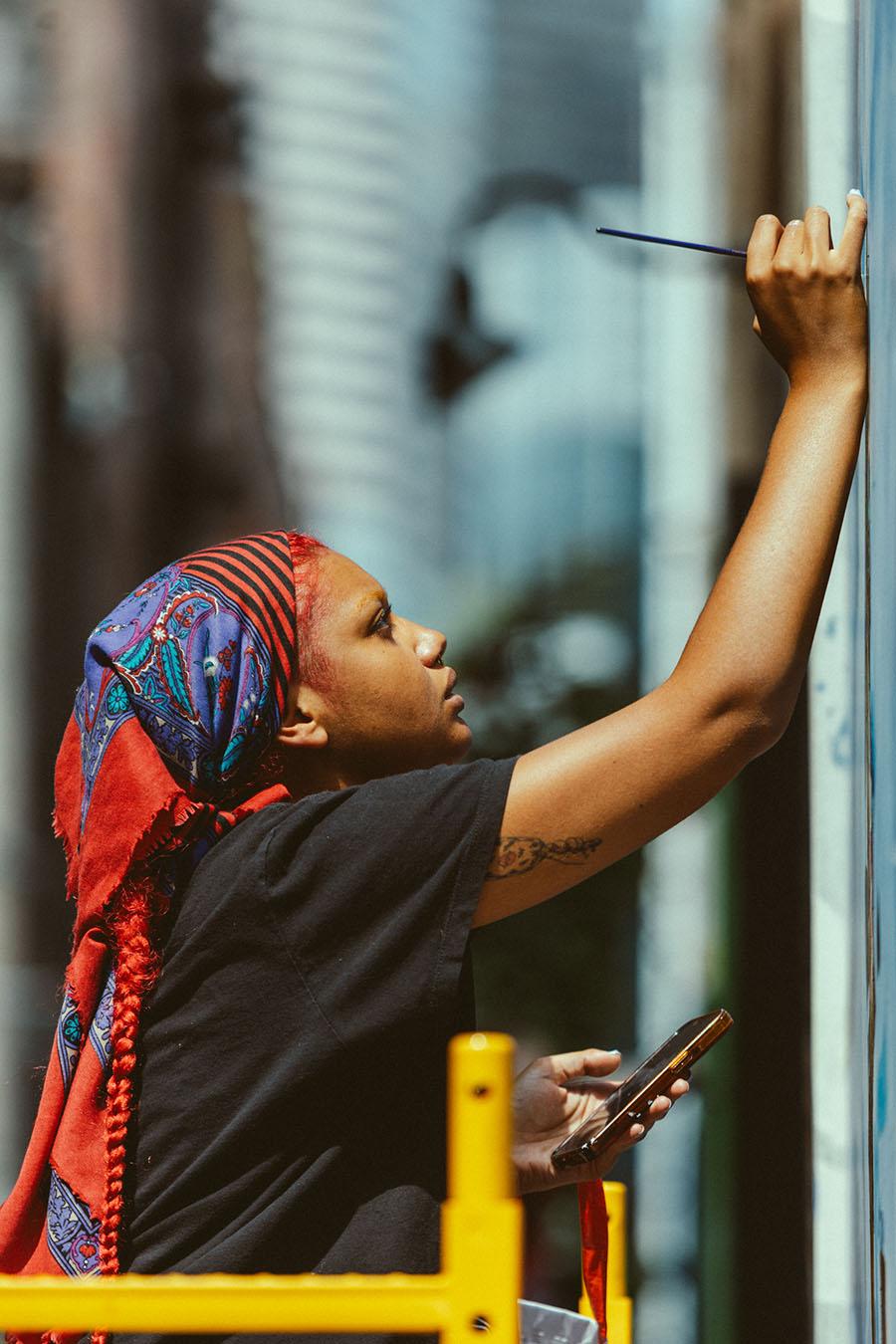
Shades on for even lower lights (and even less eye contact). I paint in the dark to better see the glow; headphones on, techno blaring in my ears as I perform a stumbling two-step amongst piles of paint and crumpled paper, brush to canvas. Somehow, I’ve convinced myself the movement helps steady my shaky, carpal-tunnel-riddled hands. The physicality of my practice often sets the tone for what the finished piece will communicate, so I have to arrive at the canvas with the energy the idea demands. With the right ratio of movement to music to energy drink, I’ve learned I can paint for days at a time. Much like dancing, painting can be an endurance sport if you make it one. It’s a very all-gas-no-brakes mentality.
Dancing My Way to Drexciya, my Boren Banner for the Frye Art Museum, was built within this mode of being—in body and out of mind. The image emerged through a reflexive process moving between my hand and machine: drawing, gathering, cutting, painting, collaging in and out of Photoshop. Snip. Cut. Scissor. Stitch. Image into image into image until the seams between what I made, what I found, what I photographed, and what I imagined became difficult to locate.
I’m interested in that slippage. The point where an image stops behaving like evidence and starts behaving like a portal. Painting has been doing this forever—cutting holes into walls and asking us to entertain the reality on the other side. Photography has historically carried a different burden: the expectation that a photograph bears some special relationship to truth because something had to exist in front of the camera in order to be photographed. But with the rapid development of image generation, computational photography, and increasingly seamless manipulation, that agreement between photography and reality feels shakier than it did even a decade ago. The old Baldessarian question—what makes us believe one image more than another?—feels newly unstable.
A photograph and a painting are both constructions. One might begin with light hitting a sensor and the other with pigment hitting a surface, but both pass through a series of decisions about what gets to remain visible and to whom that visibility is communicated: my physical audience, my virtual one, an algorithm. Frame this. Crop that. Brighten here. Remove there. Snip. Cut. Scissor. Stitch. An image is always asking us to participate in a version of reality. My paintings just make fewer promises about where that reality came from.
Bodies become architecture. Water becomes atmosphere. Sound becomes iconographic citation. Camouflage obscures while fluorescent pigment demands attention, denoting a sense of camp or absurdity. A nightclub can sink beneath the ocean and continue pulsing somewhere below us. Photographs I have taken collide with found images, drawings, digital artifacts, remembered spaces, and things that never happened at all. By the time they reach the canvas, I’m often less interested in separating fact from fiction than in what becomes possible when those categories begin to bleed together. It’s the same slippage I’m drawn to in futurism and science fiction, where speculation can operate simultaneously as warning, proposition, fantasy, and critique. There is both horror and excitement there: mind and machine, history and fiction, autonomy and control.
For me, the myth of Drexciya sits somewhere in the middle of all of this.
I danced my way to Drexciya before I painted my way there. I first encountered the Detroit techno duo while exploring playlists to paint to. Drexciya, formed by James Stinson and Gerald Donald, was active throughout the 1990s and into the early 2000s. Alongside their music, Stinson and Donald built an expansive mythology centered around the Drexciyans—an underwater civilization descended from the unborn children of pregnant African women thrown overboard during the Middle Passage. Across their records, this world emerges incrementally through sound, titles, liner notes, maps, and fragments of narrative rather than through a single complete story.
As I continue to engage with the music and myth, I’ve realized that my attraction to Drexciya lies in this fractured construction. Horror is not erased but transformed, stretched through fiction into something strange enough to hold another possibility. Sound gives an imagined place texture. Fragments become history. Fiction accumulates until it begins to feel geographic.
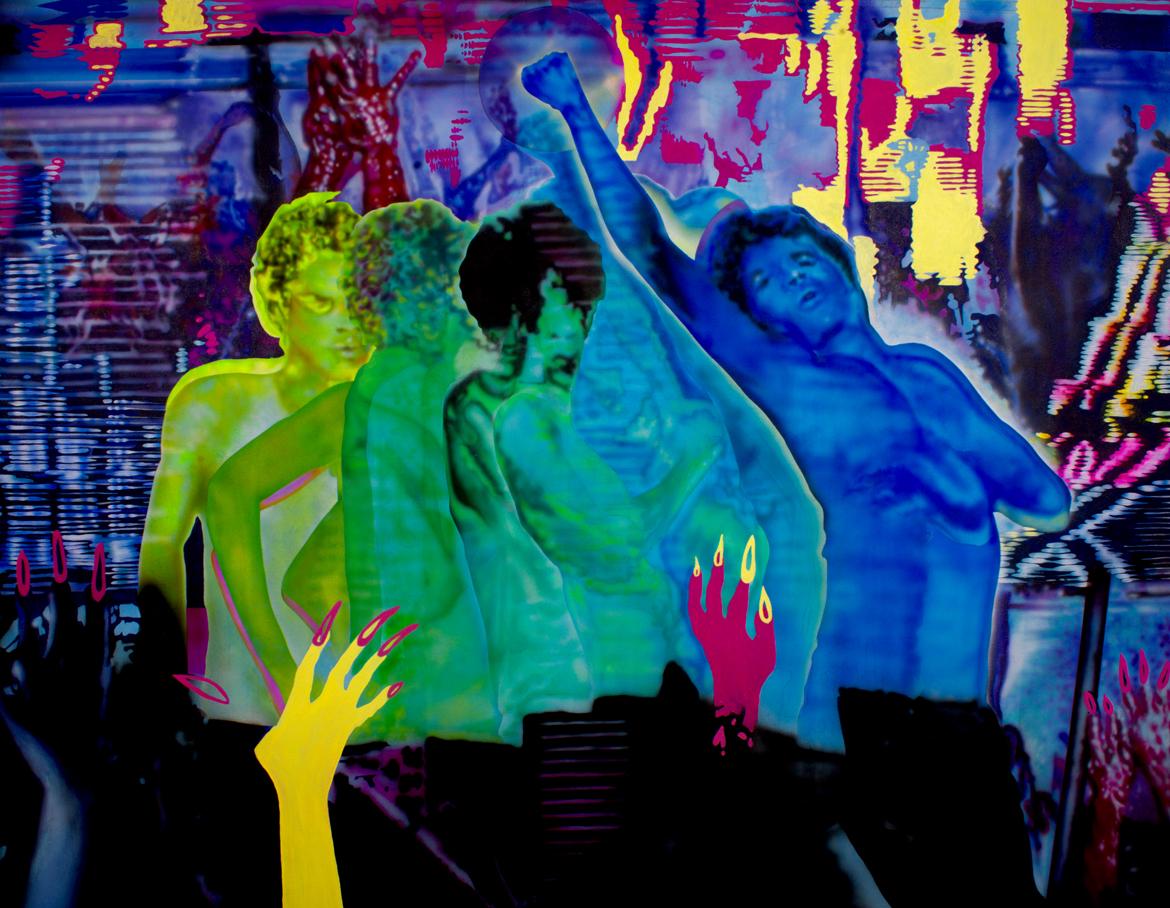
I find something similar in queer nightlife. The dance floor pulls together bodies, sound, architecture, costume, light, and narrative to temporarily make somewhere else. A dark room becomes a world. Bodies become characters, witnesses, architecture. Identities can be exaggerated, obscured, performed, or abandoned altogether. There is horror here too—in the histories that make these spaces necessary, in the grotesque, the excessive, the absurd. And there is pleasure in becoming temporarily unrecognizable. Queer nightlife does not resolve the conditions outside the club. It distorts them long enough for something else to come into view.
My paintings sit somewhere between these sites: Drexciya’s speculative mythology, the dance floor’s temporary worlds, and painting’s long history of cutting portals into otherwise solid walls. Photographs, memories, histories, digital artifacts, bodies, and imagined spaces are cut apart and reorganized. The image becomes a proposition—a familiar world rearranged just enough to reveal another one.
Maybe that is what I keep returning to: what happens in the moment something familiar changes shape. Horror becomes absurdity. History becomes fiction. A body becomes architecture. A nightclub slips underwater and keeps pulsing somewhere below us. Constructed, temporary, even impossible does not necessarily mean untrue.
I am once again stepping to an improvisational beat.
Snip. Cut. Scissor. Stitch.
Excited to see what survives the transformation.